 SaaS Explained
Cloud, hosting and multi-tenant
Last reviewed
The short version
- The cloud means computers you use over the internet, owned by someone else.
- Hosting means a company keeps your website or software running on its computers.
- Multi-tenant means many customers share one copy of a program, each with their own private space.
What "the cloud" means
"The cloud" is a name, not a place. It stands for computers that you reach over the internet.
NIST defines cloud computing as a model for getting a shared pool of configurable computing resources, such as servers, storage and applications.[1] You can get more of them or give them back quickly, with little effort from the provider.[1]
So the cloud is about sharing and flexibility. You use what you need, when you need it.
What "hosting" means
Hosting is a close cousin. A web host provides the infrastructure needed to run websites and make them reachable on the web.[2] Infrastructure just means the computers, storage and network cables underneath.
Cloud hosting is hosting that runs on cloud computers.
The three service models
NIST describes three ways to get cloud services. They differ in how much the provider handles for you.
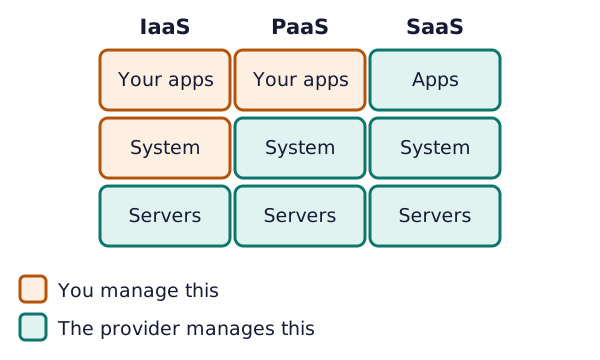
- Infrastructure as a service (IaaS). You get basic computing resources, such as processing, storage and networks.[3] You then run your own software on them.
- Platform as a service (PaaS). You put your own applications onto the provider's cloud.[4] The provider supplies the tools to run them.
- Software as a service (SaaS). You use the provider's finished applications.[5]
Moving down the list, you do less and the provider does more. The SaaS page has more on the last one.
What "multi-tenant" means
A tenant is a group of users who share access to a piece of software.[6] Think of a company, with all its staff, as one tenant.
In a multi-tenant system, a single copy of the software runs on a server and serves many tenants.[6] The opposite is multi-instance. There, each tenant gets its own separate copy.[6]
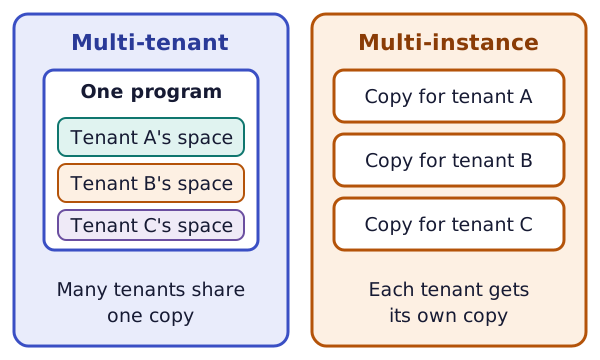
SaaS tools are typically multi-tenant.[7] Some providers also offer a separate environment.[7]
Do tenants see each other's data?
They shouldn't. In a multi-tenant design, the software is built so that customers don't share or see each other's data.[6] The walls are made in the software itself.
Whether a given provider has built those walls well is a different question. This page can't answer it. A SOC 2 report is one document that may help you ask.
Sources
- cloud computing - Glossary, NIST (accessed 2026-11-18)
- Web hosting service, Wikipedia (accessed 2026-11-18)
- Infrastructure as a Service (IaaS) - Glossary, NIST (accessed 2026-11-18)
- Platform as a Service (PaaS) - Glossary, NIST (accessed 2026-11-18)
- Software as a Service (SaaS) - Glossary, NIST (accessed 2026-11-18)
- Multitenancy, Wikipedia (accessed 2026-11-18)
- Software as a service, Wikipedia (accessed 2026-11-18)