 SaaS Explained
Data portability and leaving a service
Last reviewed
The short version
- Data portability means you can take your data out of a service and move it somewhere else.
- A good export is a file you can open without that service.
- Check this before you rely on a tool, not after your subscription ends.
What the term means
When your data lives in someone else's software, it can get stuck there. Wikipedia describes data portability as a concept meant to protect users from having their data stored in closed "silos".[1] Silos make backups hard and moving between services hard too.[1]
Wikipedia ties this to vendor lock-in.[1] That means being stuck with one provider because leaving is too hard. Portability is the way out.
One point of care. The term is used in privacy law as well, where it applies to personal data.[1] This page is about the everyday question: can you get your business records out? It isn't legal advice. For rights and contracts, ask a lawyer.
What an export looks like
An export is a copy of your data saved as a file. Wikipedia gives the example of exporting user data into a local file the user can access.[1]
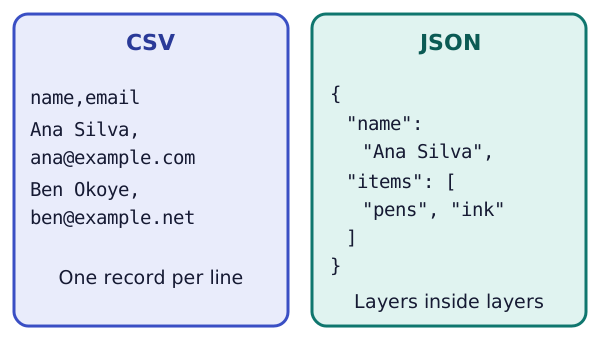
Two file types come up a lot.
CSV stands for comma-separated values. The format has long been used to move data between spreadsheet programs.[2] Each record sits on its own line.[2] Here is a made-up export of two customers:
name,email
Ana Silva,[email protected]
Ben Okoye,[email protected]
JSON is a lightweight, text-based format for exchanging data.[3] It suits data with layers, such as an order with several items inside it.
Not every service offers an export
Wikipedia notes that many platforms lack even partial export options.[1] So never assume. Look for it.
Before you rely on a tool
You can look for the answers in the provider's help pages and terms. Ask:
- Can I export all of my data, or only some of it?
- Which file types do I get?
- Can I do it myself at any time, or only by asking support?
- Does the export keep attachments, notes and dates?
- What happens to my data after my subscription ends? How long is it kept, and when is it deleted?
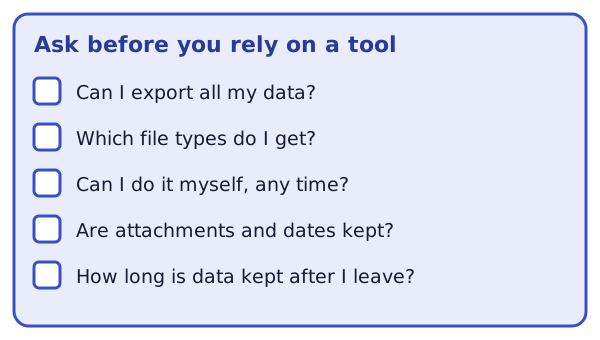
The last question matters most. It decides how long you have to get your files. This page can't say what any one provider does. The terms tell you.
Try it early
Run a test export while you still have time. Open the file. Check that it holds what you expect.
For questions about contracts or your legal rights over data, ask a qualified lawyer.
Sources
- Data portability, Wikipedia (accessed 2026-11-18)
- RFC 4180: Common Format and MIME Type for Comma-Separated Values (CSV) Files, IETF (accessed 2026-11-18)
- RFC 8259: The JavaScript Object Notation (JSON) Data Interchange Format, IETF (accessed 2026-11-18)