 SaaS Explained
Multi-factor authentication
Last reviewed
The short version
- Authentication means proving you are who you say you are.
- Multi-factor authentication (MFA) asks for two or more different kinds of proof.
- It helps because a stolen password alone isn't enough to get in.
What a "factor" is
A factor is one kind of proof. NIST defines MFA as authentication using two or more different factors.[1]
There are three kinds of factor:[1]
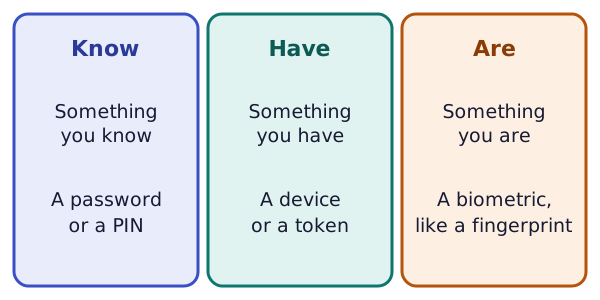
- Something you know. A password or a PIN.[1]
- Something you have. A device or a token that only you hold.[1]
- Something you are. A feature of your body. NIST's example is a biometric.[1] A biometric is a measurement of your body, such as a fingerprint.
Why "different" matters
The word different is doing real work. A password plus a second password is two proofs of the same kind. Both are things you know.
A password plus a code from your phone is two kinds. That is MFA.
What it looks like when you sign in
CISA gives two common examples of the second step. One is a code texted to your phone. The other is a code made by an authenticator app.[2] An authenticator app is a small program on your phone that shows a new code every so often.
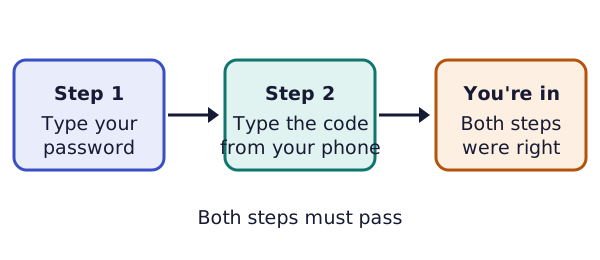
First you type your password. Then you type the code. Both must be right.
Why it helps
Say someone steals your password. With MFA turned on, they still can't get past the second step.[2] Without it, the password alone would be enough.
MFA doesn't make an account unbreakable. It makes a stolen password much less useful.
Questions to ask about a software tool
When you look at a business tool, you can ask:
- Does it offer MFA at all?
- Which second steps does it allow: texted codes, an app, a physical key?
- Can an admin require everyone on the team to use it?
The answers sit in the provider's help pages or sales team. This site doesn't judge any tool's answers.
Security reports sometimes list MFA as an example of a control.[3] The SOC 2 page explains those reports.
For advice on your own setup, ask a qualified security professional.
Sources
- multi-factor authentication - Glossary, NIST (accessed 2026-11-18)
- Turn On MFA, CISA (accessed 2026-11-18)
- System and organization controls, Wikipedia (accessed 2026-11-18)